Adding it to an existing app
You don't have to rewrite anything to start. A route without @api_version is given
default_version, which is v1.0 under SemVer, so the app you have today is already "version 1".
The steps below keep the unversioned URLs working while your clients move to the versioned ones.
1. Versionize what you have
This is an ordinary app, with its router included once:
Pass the same router to RouterVersioner and call .versionize(), leaving everything above as it is:
Nothing is decorated, so GET /items is mounted as GET /v1_0/items, with its own docs at /v1_0/docs.
GET /items keeps answering too: app.include_router(router) is still there, and RouterVersioner doesn't touch it.
2. Change an endpoint in a new version
Declare the new one at a higher version, next to the old one. The old function stays exactly as it was:
| URL | Answered by |
|---|---|
/items |
the original function, as before |
/v1_0/items |
the original function |
/v2_0/items |
the new function |
The unversioned URL does not follow the new version
/items is served by the router you included yourself, and FastAPI answers with the first route that matches: the original function. It never moves to v2.0, so clients still on it see no change.
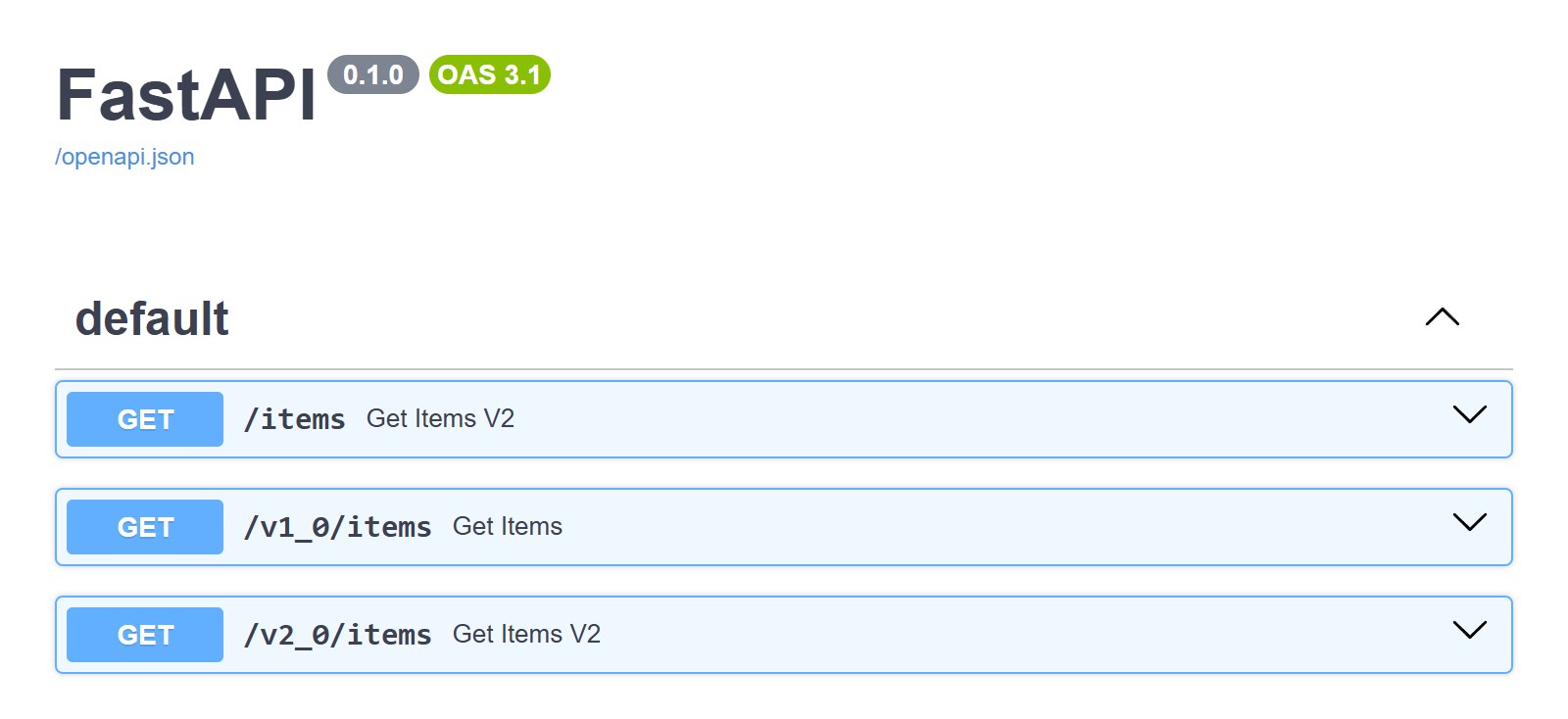
The app's own docs, at /docs, list the unversioned URL together with every versioned one, while each version's docs list only its own routes:
Don't read the unversioned URL from /docs
FastAPI keeps one operation per path and method in a schema, the last one declared. So /docs describes /items with the v2.0 function ("Get Items V2" above), while requests to /items are answered by the original one. Use /v1_0/docs and /v2_0/docs as the reference for what each version returns.
3. Retire the unversioned URLs
Once your clients call the versioned URLs, remove app.include_router(router). If you still want a URL that always means "the newest", latest_prefix adds one:
RouterVersioner(
    app=app, routers=router,
    version_format=VersionFormat.SEMVER,
    latest_prefix="/latest",
).versionize()
/items now answers 404, and /latest/items serves whichever version is highest: see the latest alias.
Call .versionize() once, after every route is declared, as in the Quick start. To take a route out of a version later, or to mark it deprecated first, see the route lifecycle.