Route lifecycle
deprecate_in and remove_in describe when a route changes status, without needing a
separate route definition per version:
@router.get("/legacy")
@api_version((1, 0), deprecate_in=(2, 0), remove_in=(3, 0))
def legacy_route():
    return {"msg": "I am stable in v1, deprecated in v2, gone in v3."}
| Version | /legacy present? |
Marked deprecated? |
|---|---|---|
| v1.0 | yes | no |
| v2.0 | yes | yes |
| v3.0 | no | n/a |
Deprecation without removal
remove_in is optional: deprecate_in alone marks a route deprecated from that version
onward with no planned removal, staying available (and deprecated) in every later version.
Routes without @api_version
A route without @api_version isn't excluded; it falls back to default_version
((1, 0) for SemVer, "1" for CalVer, unless overridden).
FastAPI's own deprecated flag
FastAPI's own deprecated=True (set directly on a route, or inherited from
APIRouter(deprecated=True)) is preserved as-is: RouterVersioner copies it into every
version unconditionally, on top of whatever deprecate_in computes. deprecate_in only
ever turns deprecation on for versions at or after its boundary; it never turns off a
deprecated=True that was already set natively.
Use one or the other
If you set both on the same route, it shows as deprecated in every version, including ones before deprecate_in's boundary. Use deprecated=True for an unconditional, version-independent flag, and deprecate_in for a per-version lifecycle.
One method of a multi-method route
A route with methods=["GET", "POST"] can have just one of its methods taken over by a
dedicated route in a later version; the other method keeps being served by the original
route. See semver_app.py
for a working example.
In the generated docs
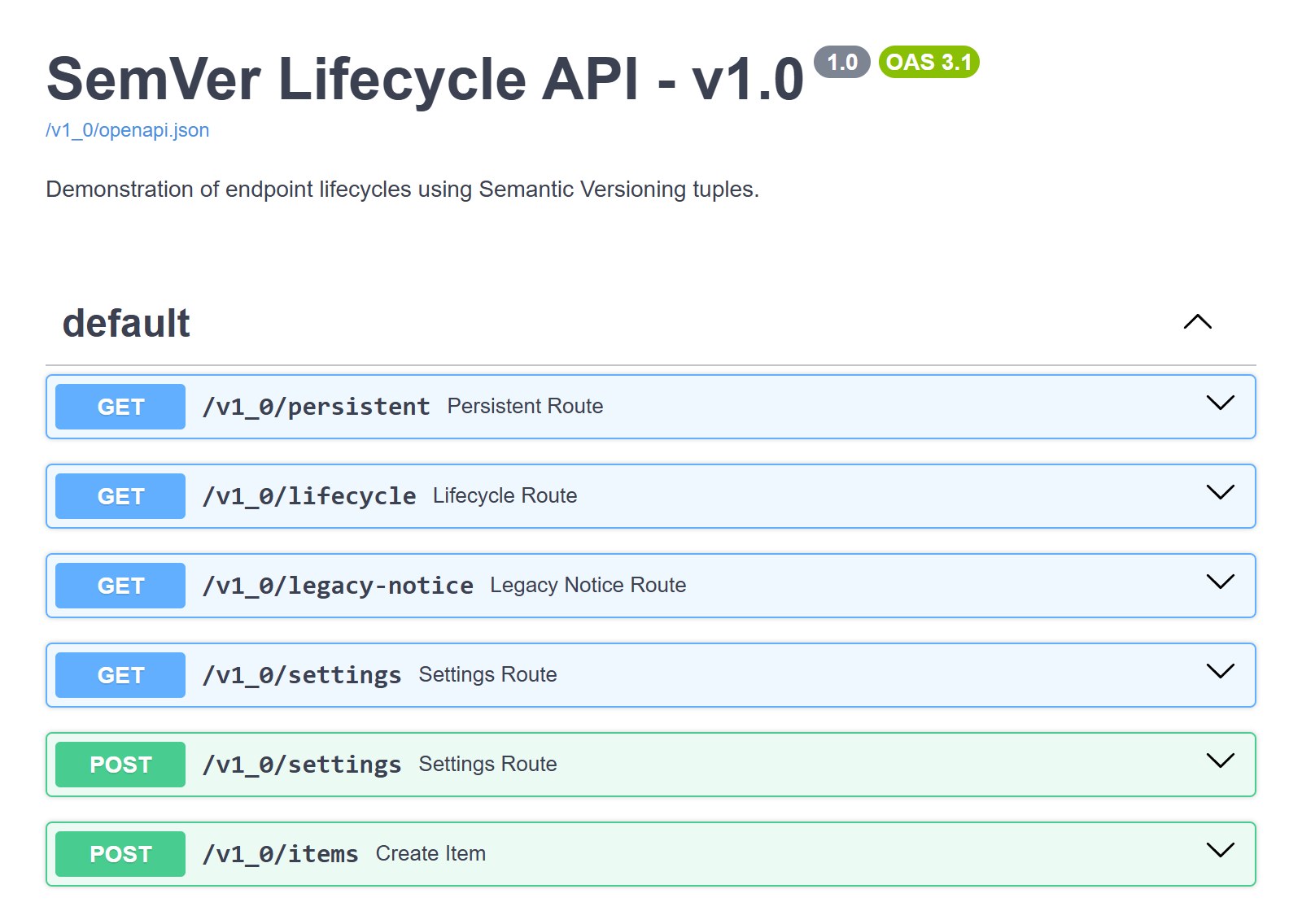
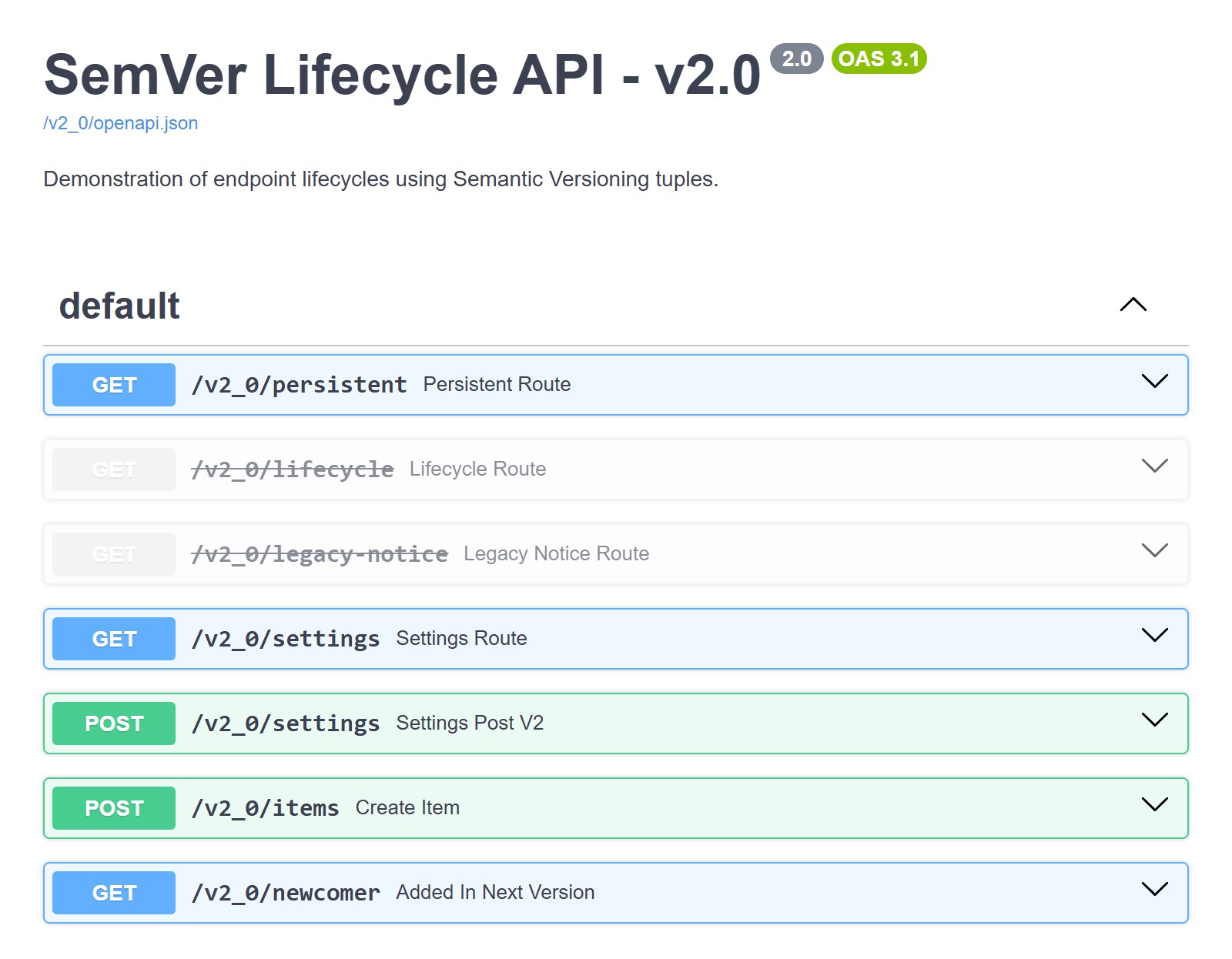
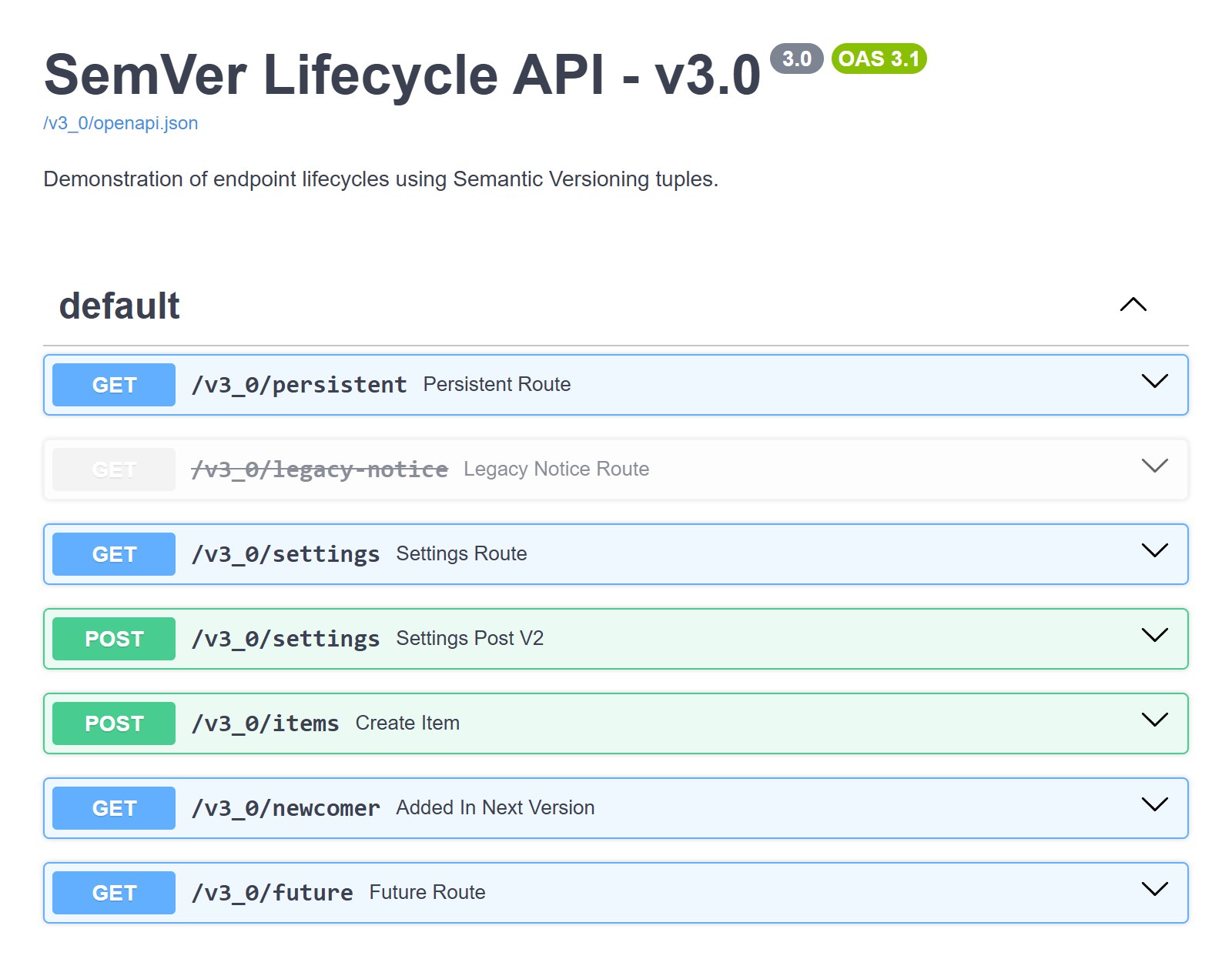
In each version's Swagger UI and ReDoc, a route in its deprecation window is struck through, a route
removed from a version is absent, and a route introduced later appears only from that version. These are
v1.0, v2.0 and v3.0 of semver_app.py:
/lifecycle and /legacy-notice are active, and /newcomer and /future don't exist yet.
/lifecycle and /legacy-notice are deprecated from v2.0, and /newcomer is introduced in it.
/lifecycle is removed. /legacy-notice has no remove_in, so it stays, still deprecated, and /future is introduced.
Deprecation headers
Routes in their deprecation window can also emit Deprecation, Sunset and Link response
headers to clients; see Deprecation headers.