Version discovery
RouterVersioner(
    app=app,
    routers=router,
    version_format=VersionFormat.SEMVER,
    include_versions_route=True,
).versionize()
GET /versions
{
  "versions": [
    {
      "version": "1.0",
      "openapi_url": "/v1_0/openapi.json",
      "swagger_url": "/v1_0/docs",
      "redoc_url": "/v1_0/redoc"
    }
  ]
}
Pass versions_route_path="/api-versions" (any path starting with /) to mount the endpoint
somewhere other than /versions.
A version whose VersionInfo sets guide also carries a "guide_url" in its entry, sent as
given (an external URL, with no root_path prefix).
If several RouterVersioner instances share one app and all set include_versions_route=True,
/versions is mounted once and lists every instance's versions together, instead of the
first instance shadowing the rest (see Multiple routers). That single
endpoint is mounted by the first of those instances, which also fixes its path: a different
versions_route_path passed by a later instance has no effect.
Set include_versions_dashboard=True for an HTML counterpart: a page (at /dashboard by
default, moved with versions_dashboard_path) headed by the app's title and version and
listing the same versions with links to each one's Swagger, ReDoc, openapi.json, and its
guide when version_info gives one. It aggregates across instances and follows the same
first-instance-wins rule, works whether or not include_versions_route is also on, and is
kept out of the OpenAPI schema. The built-in page is plain; pass
versions_dashboard_hook(version_models, root_path) -> str to render your own instead (it
isn't handed the app metadata, so read app.title / app.version off your own app reference
if you want them).
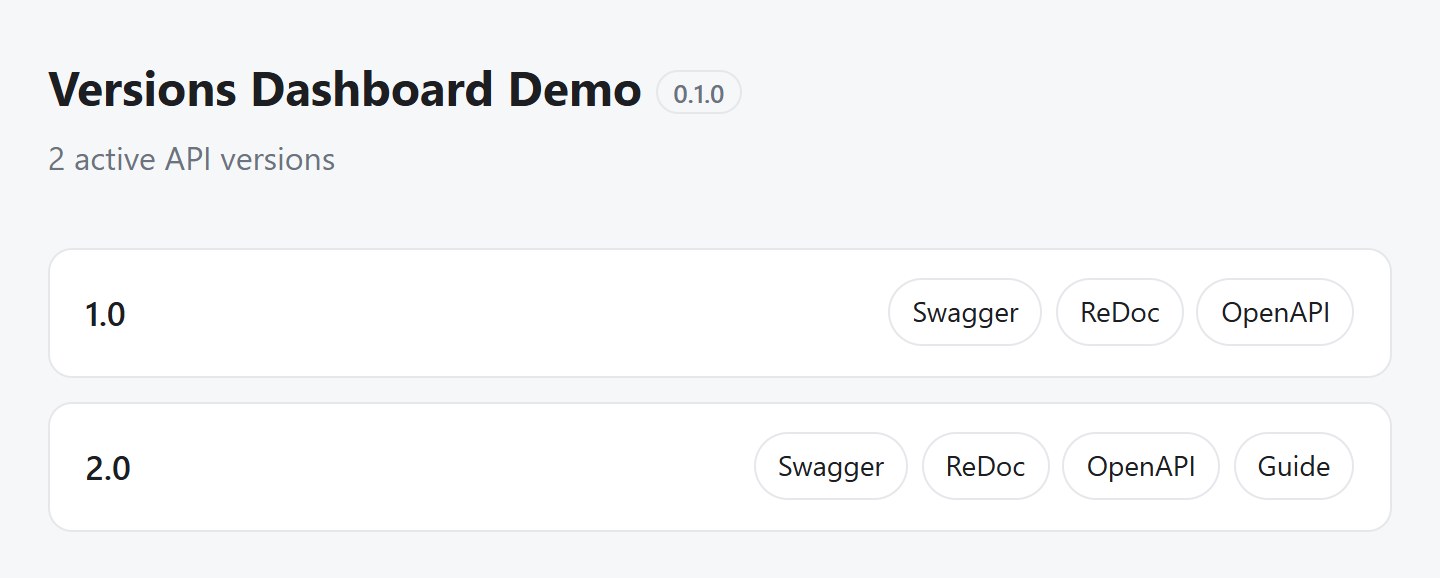
The built-in dashboard, from versions_dashboard_app.py.